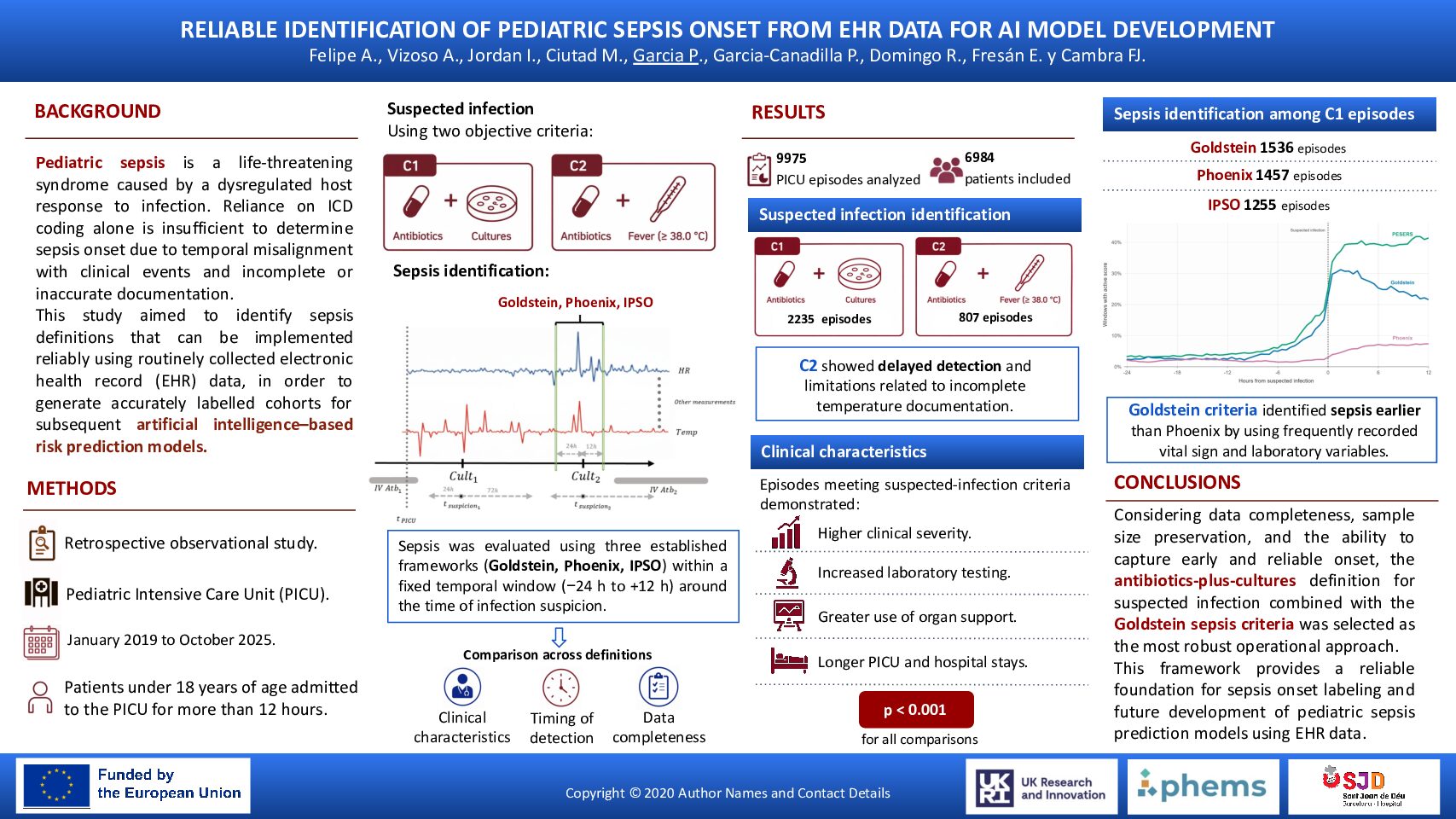
New research from the PHEMS project has been presented at ESPID 2026, focusing on how collected Electronic Health Record (EHR) data can be used to reliably identify the onset of paediatric sepsis and support the development of artificial intelligence (AI) models.
The study evaluates different operation definitions of sepsis to determine which approach can provide the most reliable and accurately labelled datasets for AI model development. Using retrospective data from a Paediatric Intensive Care Unit (PICU), the researchers compared established sepsis frameworks, including the Goldstein, Phoenix and IPSO criteria, taking into account the timing of detection, data completeness and clinical performance.
The findings indicate that combining an antibiotics-plus-cultures definition for suspected infection with the Goldstein sepsis criteria provides the most reliable operational framework for identifying the onset of sepsis.
The work contributes to the broader PHEMS mission to advance federated health data research and trustworthy AI for paediatric healthcare across Europe, supporting the development of innovative approaches that can translate collected clinical data into meaningful improvements in patient care.